
You de-escalate things all day. A parent catches you at pickup, upset about something that happened in the two-year-old room, and within ninety seconds you've heard them out, lowered the temperature, and walked them to their car feeling better than when they arrived. You do it by instinct. You're good at it.
Then the same kind of frustration shows up in your inbox at 5pm on a long day, and you do the responsible thing — you answer it. You don't let it sit. You read it, write back something clear and accurate, and send it so it's handled before you walk out the door.
Except it isn't handled.
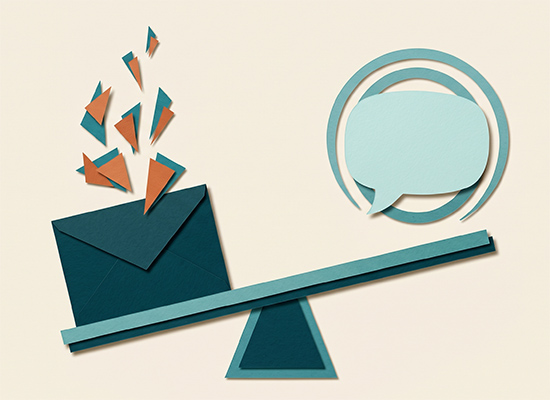
A reply can be completely accurate and still do the opposite of what you needed it to do.
You answered the message — but answering a message and settling a situation aren't the same job. You may not feel the difference until three days later, when a conversation that could have taken five minutes has grown into a crisis that takes far more.
This is the trap. Typing a reply and talking someone down feel like the same act, and they aren't. A good in-person response does two things at once: it gives the person your time, and it carries your warmth. A reply sent to clear the inbox usually does neither. The channel that feels most efficient is the one where directors lose the most ground.
The fix isn't a new skill. You already have it — you use it in the hallway every day. It's learning to notice the moment you've shifted from talking to typing, and bringing the hallway version of yourself to the keyboard. That's one habit, not ten.
A Cold Reply Doesn't Resolve — It Documents
A cold reply doesn't end the problem. It records it.
Take that frustrated parent — confused about pickup, maybe, or half-informed about something in the classroom. Her message has an edge to it, but it isn't unreasonable. A reply that's accurate but cold — no warmth, no attempt to fill in what she's missing, just here's the policy, this is how it is — never touches the part of her that's upset.
So she reads it twice. The second time, she's angrier. She forwards it to her spouse, then cc's someone on the next message. A fixable misunderstanding becomes a written record of a grievance — and you built the record yourself.
It happens with staff just as often. A teacher pushes back on a schedule change or a write-up, the reply comes back clipped and final, and a manageable conversation hardens into a standoff that now has a paper trail. Same pattern, same cost.
Why Writing Makes It Worse
In person, your words travel with everything around them — your tone, your pace, the warmth on your face. Much of the reassurance is in the delivery, not the words. Email and text messages send the words alone. Tone, expression, the small pause that says I'm taking this seriously — none of it makes the trip.
So the reader fills those gaps in for you, reading between the lines of whatever you sent. And a frustrated reader fills them with the worst version: the neutral line reads as cold, the short one as dismissive, the factual one as a brush-off. And a text message makes it worse still: the words come even more clipped than an email, leaving even more blank space to fill.
Speed compounds it. A reply fired off to clear your inbox hasn't been given the time an in-person response naturally takes — so even the right words land flatter than you meant them. You're not just failing to calm the situation.
You're handing the other person a blank space and trusting them, at their angriest, to fill it in generously. They won't.
That's why the medium matters more than the wording. A phone call or a face-to-face carries the warmth, understanding, and connection that text strips out. Voice calms what text escalates — not because voice is softer, but because it leaves nothing to the imagination. When a concern has real feeling in it, that's the channel it deserves.
When to Email, When to Talk
Not every message needs a phone call. Most of your inbox is logistics, and logistics belong in writing. Closure dates, a schedule change, a policy clarification, a supply reminder, a routine confirmation — these are factual and low-charge, and answering them by email is fast and correct. Email isn't the problem. The mismatch between the message and the medium is. The call changes when the message carries weight — emotion, stakes, or the relationship itself. Here's a quick guide:
 Email is fine
 This is a conversation
When you can't tell which kind you're holding, let the charge decide, not the topic. A simple question from a calm parent is an email. The same question from a parent who's clearly frightened is a phone call. And if a message gets your guard up or pulls you toward defending yourself, treat that as the signal — the tension you're feeling is exactly what they'll read into whatever you type back.
Three Things to Check Before You Reply
When a heated or emotional message comes in, run three quick checks before you type a word.
The Ninety-Second Check
None of this requires a system. It requires about ninety seconds before you reply.
Read the message a second time — not for what it says, but for what the person needs. Are they scared? Embarrassed? Working from bad information? Then decide whether email is even the right room for this. If there's real emotion in their message, there shouldn't be much emotion in your reply — its only job is to move the conversation somewhere voice can finish it.
A short acknowledgment — "I can see this has been frustrating, and I want to make sure we get it right for you" — isn't capitulation. It's the line that keeps a problem from becoming a conflict.
Call it the ninety-second check, and run it every time a message makes your jaw tighten.
You Don't Have to Get It Perfect
You won't get this right every time. Directors who've done this for decades still send the occasional reply they'd take back — a long week, a bad day, one more thing going wrong. That isn't a flaw. It's the job.
What changes with experience isn't that the frustration goes away. It's that you get better at catching it before you hit send — at recognizing the reply you're about to write and deciding: not yet. That pause is where de-escalation actually lives. Not in a policy, not in a training — in the few seconds between reading something aggravating and choosing what to do with it.
You have more control over where these situations land than it feels like at 5pm. Your first reply is the proof.
Worth Remembering
- A reply can be completely accurate and still escalate the situation. Answering a message and de-escalating one aren't the same job.
- Text sends your words without your tone, your face, or your pace — so a frustrated reader fills in the gaps, and usually with the worst version.
- Speed works against you. A reply fired off to clear the inbox rarely gets the time it needs to land the way you meant it.
- When a message carries real charge, the strongest reply is often a short one that moves the conversation to a call or in person, where warmth travels with the words.
- The pause is the practice. Most de-escalation happens in the ninety seconds between reading something aggravating and deciding what to do with it.
Reflection Questions
- Think back to the last charged message you answered in writing. Did your reply settle the situation, or did it just respond to it?
- When a message makes your jaw tighten, what's your honest default — reply now to be done with it, or wait until you're ready?
- Which conversation from the past month might have gone differently as a phone call or a face-to-face?
- What would it take to build a ninety-second pause into your routine, especially on the days you have the least patience for it?
When email is the right call
Plenty of messages belong in writing — the warm thank-you, the welcome note, the gentle "can we find time to talk?" that moves a hard conversation off the screen. We've written those for you. The Email Template Library is director-tested, ready to edit, and built to sound like you on your most composed day.
What's New
Stay current on our most recently published articles.